Let’s be honest with each other for a second. Nobody wakes up on a Tuesday morning in Morris County excited to think about asphalt. You have tenants complaining about the HVAC, payroll to run, supply chain issues, and a dozen other fires to put out. The parking lot is usually the last thing on your mind until it becomes a problem.
But take a drive down Route 10 or Route 46. Turn into a random strip mall in Chester or an office park in Florham Park. What is the first thing you notice?
It isn't the signage. It isn't the landscaping or the window displays. It’s the bump you just hit that spilled coffee on your shirt. It’s the faded lines that make you unsure where to park. It’s the massive puddle right in front of the entrance that forces you to hopscotch your way to the door.
Your parking lot is the first handshake your business offers to the world. It sets the tone before a customer even walks through your door. If it is smooth, dark, and freshly painted, nobody notices it and that is exactly the point. It feels safe. It feels professional.
But if it is a minefield of cracks, potholes, and crumbling blacktop? It screams "neglect." It tells your customers, "If they don't care about the outside, they probably don't care about the inside." In a state as competitive as New Jersey, that is a first impression you simply can’t afford.
At Black Diamond Paving & Construction, we have been fixing NJ parking lots for over 20 years. We’ve seen it all from simple resurfacing jobs to total disasters where the ground was sinking. This guide is about what you, as a business owner, actually need to know to spend your budget wisely and get a lot that lasts.
Why NJ Asphalt Takes a Beating (And Why You Should Care)
If you have lived in Jersey for more than a year, you know our weather has serious mood swings. We get baking 90-degree humid summers that soften the asphalt, and then we get winters that freeze the pipes. That specific combination is brutal on pavement.
It isn't just the cold, it’s the Freeze-Thaw Cycle that does the real damage to commercial asphalt paving in NJ.
Think of your parking lot like a sponge. Asphalt is porous. Over time, tiny cracks form. When it rains or snows, water seeps into those cracks. That’s fine, until the sun goes down. When the temperature in Sussex or Warren County drops below freezing overnight, that trapped water turns to ice.
Water expands when it freezes. It pushes the asphalt apart with incredible force. The next day, the sun comes out, the ice melts, and leaves a void. The asphalt settles, and the crack gets a little wider. Rinse and repeat that process dozens of times over a single winter, and by March, what was a hairline crack is now a pothole big enough to swallow a tire.
Add in the thousands of pounds of rock salt and chemical de-icers we dump to keep people safe (which dries out the asphalt binder), and it is a miracle our roads survive at all. This is why you can’t just use any generic paving mix, you need a contractor who understands local conditions.
The Puddle Problem: Why Drainage is Everything
Here is something a lot of pavers won't tell you: The asphalt is only as good as the drainage.
You can lay the most expensive, high-quality blacktop in the world, but if the water has nowhere to go, that lot will fail in five years, guaranteed. Water is the enemy. If you have standing water (we call it "birdbaths") in your lot, that water is slowly eating away at the bonds in the asphalt.
Before we even talk about paving, we look at the grades. Is the lot sloping correctly toward the catch basins? Are the catch basins themselves collapsing? (This happens constantly in NJ, when the bricks inside the basin crumble, and the asphalt around the drain starts to sink).
When we come out for an estimate, we are looking for these drainage issues first. Sometimes, we have to install trench drains or re-grade the stone base to make sure the water flows off the surface. It costs a little more upfront, but it saves you a fortune in repairs later.
The Big Question: Patch It, Cap It, or Rip It?
When a property manager calls us, the conversation usually starts with: "Do I really need to rip this whole thing up, or can we just cover it?"
We get it. Paving is expensive. You don’t want to burn capital reserves if you don’t have to. But putting a Band-Aid on a broken leg doesn't work. We look at the "bones" of the lot to help you decide.
1. The Facelift: If your foundation is solid, meaning the ground underneath isn't sinking or shifting, we can usually save you some money with parking lot resurfacing in NJ.
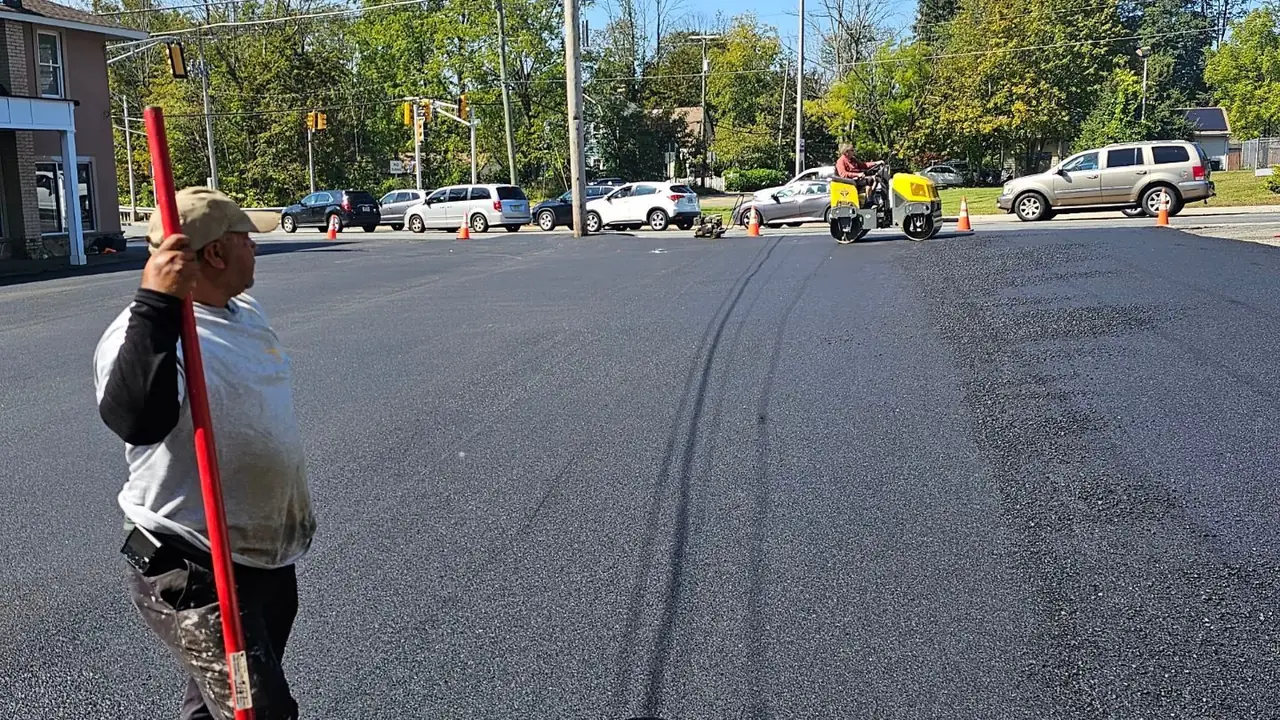
This is the most common option for lots that are 15 to 20 years old. We bring in a milling machine (a giant grinder) and scrape off the top 1.5 to 2 inches of the old, gray, oxidized asphalt. We sweep it clean, apply a tack coat (the glue), and lay down a fresh, hot black mat.
This makes the lot look brand new for a fraction of the cost of replacement. However, if there are cracks in the bottom layer, they will eventually reflect through to the top. It's not a permanent fix, but it buys you a good 10 to 15 years.
2. The Fresh Start: Full Excavation if you see "alligator cracking" (where the pavement looks like reptile scales) that is bad news. That pattern means the stone base underneath has failed. The dirt has turned to mud, and the asphalt is moving around on top of it.
Putting new asphalt on top of alligator cracking is like painting over rot. It will look good for six months, and then it will fall apart. In this case, we have to dig. We excavate the bad asphalt, remove the wet or soft soil, install a new stone base, compact it until it's rock-hard, and then pave. It’s the only way to fix it right.
The Low Bid Trap
We have to mention this because we see business owners get burned by it every season. You get three quotes. Two of them are around $50,000, and one guy comes in at $35,000.
You take the $35,000 quote, right?
Here is the problem. Asphalt is a commodity. We all buy it from the same plants for roughly the same price. Labor costs are standard. So, how is that one guy doing it $15,000 cheaper?
● He might be laying the asphalt 1.5 inches thick instead of the required 2 inches (you won't know until it cracks two years later).
● He might be skipping the tack coat (the glue that bonds the layers).
● He might not have proper insurance, leaving you liable if a worker gets hurt on your property.
At Black Diamond, we price things fair, but we price them to be done right. We don’t scrimp on materials. If the spec says 2 inches compacted, you get 2 inches compacted.
What Actually Happens When We Show Up? (The Logistics)
The biggest fear property managers have isn't the cost, it's the disruption. "How are my customers going to park? Will my tenants scream at me?"
We know that closing your lot feels like closing your business. That’s why we specialize in phased paving. We don't just show up and block the whole entrance. We treat your property like a chessboard.
For a typical commercial job, we might pave the back half on Monday and Tuesday while keeping the front half open for customers. Then, once the back gets dry, we flip it. For high traffic businesses, we often schedule the heavy demolition work for off-hours or weekends.
We handle the traffic control with cones, caution tape, and signage, so drivers know exactly where to go. It’s a messy process (it involves heavy machinery and hot tar, after all), but we keep the site as clean and organized as possible.
A Quick Note on the Law (ADA Compliance)
This isn't the fun part, but it is the "don't get sued" part. New Jersey is strict about the Americans with Disabilities Act (ADA).
If you touch your parking lot even just to resurface it or sealcoat it, you are legally triggered to bring your handicap spots up to current code. The laws have changed over the years. What was compliant in 2010 might not be compliant today.
That means the slope of the handicap stall can’t be too steep (max 2% grade) so a wheelchair doesn't roll away. You need specific "Van Accessible" aisles that are wide enough for a ramp deployment. You need the right signage at the right height.